
March 9, 2026 | by Bella Week
Originally published in City Limits.
“It’s covering cars. It’s clogging air conditioners,” said Kimberly Comes, a tenant at NYCHA’s Redfern Houses. She and neighbors hope to close the construction debris recycling facility across the street, citing a 2023 state law meant to address the concentration of industrial sites in low-income communities and communities of color.
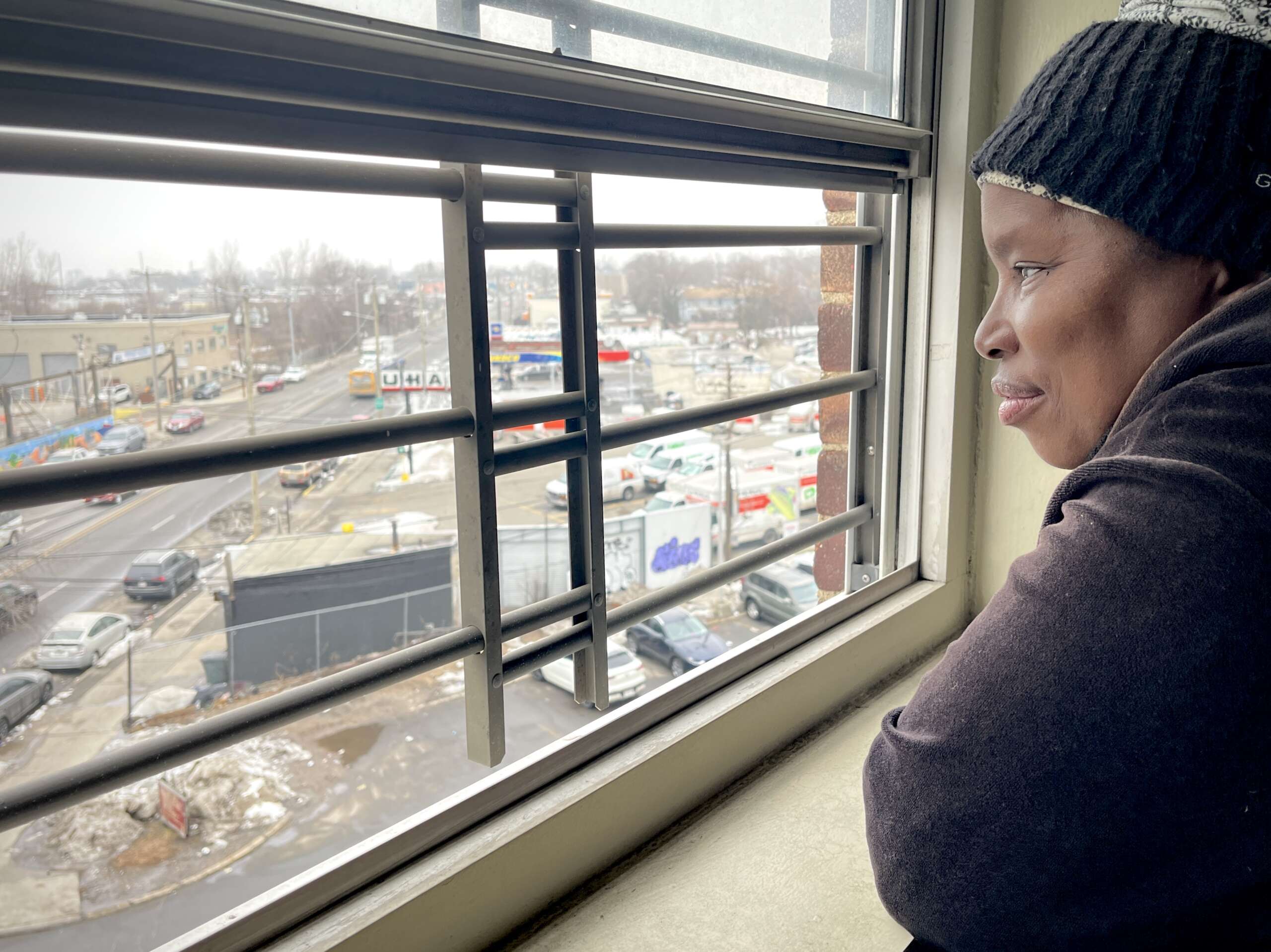
From the window of a one-bedroom apartment at NYCHA’s Redfern Houses in Far Rockaway, Kimberly Comes can see piles of crushed concrete rising above the walls of an industrial yard across the street. Wind off the bay, she said, regularly carries dust from the site into the public housing complex.
“It’s covering cars. It’s clogging air conditioners,” said Comes, who has lived at Redfern for over 35 years and is president of the Resident Council. “It’s coming into people’s apartments through the windows.”
Across from Redfern, which is home to more than 1,400 people, the Inwood Material Terminal (IMT) crushes construction and demolition debris—including concrete, asphalt, brick, and rock—into recycled material. The facility has been operated by the Haugland Group since 2015.
Now IMT is seeking a new state permit to comply with updated Solid Waste Management regulations adopted in July 2023. The application is now being reviewed under the standards of New York’s 2023 Environmental Justice Siting Law, which requires the state Department of Environmental Conservation (DEC) to consider the cumulative pollution burden on neighborhoods when making permitting decisions.
It also prohibits the DEC from granting permits that might cause or contribute to a “disproportionate or inequitable” pollution burden on communities that the state has designated as disadvantaged. IMT sits in one such community.
Redfern residents are urging the state to deny the permit. In the meantime, the facility remains open while its application is under review, and there’s no set deadline for regulators to make a decision.

People who live at Redfern say that for years, dark dust from the facility has coated playgrounds and cars and settled inside their homes.
“The car is visual proof,” said Latisha Lambert, who has lived at Redfern for nine years. She said she gave up on washing her car because it doesn’t stay clean. “I’m not talking about 24 hours later,” she said. “It’s the next morning.”
Inside their apartments, residents describe having to constantly wipe down surfaces. “You can clean the floors one day and the following day it’s covered in dust and ash,” said Loinsworth Sankarsingh. “It doesn’t matter if you keep the windows closed either; there’s no such thing as an airtight seal.”
Comes said that before she showers, she rinses a visible layer of dirt from her bathtub, watching the water turn brown as it runs down the drain.

While residents describe cleaning as a constant chore, many say their biggest concern is what the dust could be doing to their health. “I get up in the morning with a runny nose. The runny nose turns into really thick phlegm,” Sankarsingh said. “No matter how much I clear my nostrils or clear my throat, it doesn’t go away.”
Lambert, who has asthma, worries about long-term exposure. “It’s going to affect your health. It’s dust and pollution,” she said. “Especially if you’re like me, you have asthma. It’s a lot.”
Ruth Trusty, who uses a CPAP machine for sleep apnea, said particles that come through her air conditioner irritate her lungs. “I don’t have asthma, but I do have an inhaler because I cough a lot,” she said. “It’s not healthy.”
Some of the materials IMT processes contain crystalline silica. Prolonged exposure to respirable silica is known to increase the risk of cancer and lung disease.
Concerns about dust from concrete recycling facilities have surfaced in other parts of the city. In 2025, the city announced it was closing down a Department of Transportation facility in the Columbia Street Waterfront District of Brooklyn after residents complained of thick dust blanketing their cars and affecting their health.

Last July, IMT distributed air purifiers to Redfern residents who filled out request forms. Comes said the machines make little difference indoors and do nothing to address what happens outside.
“When I go back outside to pick up my grandkids, go food shopping, I’m inhaling,” she said. “So what’s the point?”
In a statement, Rosalie Drago, vice president of external affairs and strategic engagement for Haugland Group, said the company has worked with residents and local legislators over the past year to address their concerns and has implemented new mitigation measures.
She added that IMT plays a key role in the region’s sustainable infrastructure by processing construction materials and transporting them by barge, removing thousands of trucks from roads each year. She said the company is committed to balancing regional infrastructure needs with community expectations.
“We recognize the importance of this facility to the construction and reuse ecosystem,” Drago said. “But we also hear the concerns of our neighbors.”
The dispute over IMT’s future is unfolding under a new regulatory framework, reshaped by New York’s Environmental Justice Siting Law, which took effect in December 2024 and seeks to address the longstanding concentration of waste and industrial facilities in low-income communities and communities of color. IMT is located in a disadvantaged community, identified using factors such as income levels, public health data and existing environmental burdens.
In August 2023, the Haugland Group applied for the Solid Waste Management permit required under new DEC rules that ended a long-standing practice of allowing construction recycling facilities to operate with simple registrations. Previously, the DEC had no power to deny such registrations, but the 2023 regulatory change now requires these facilities to obtain a permit to continue operating.*
Two months later, the DEC deemed the application incomplete and requested additional materials, including analyses of greenhouse gas emissions and other pollutants, as well as an evaluation of the facility’s impact on the surrounding community.
Since then, the agency has issued additional notices of incomplete materials. In January, it requested that IMT prepare an Existing Burden Report. The agency is now waiting for the company to submit that report.
The DEC has not provided a deadline for the submission or approval of the required materials. In the meantime, the facility can continue operating.
Paula Segal, an attorney with TakeRoot Justice supporting Redfern residents, said the open-ended timeline undermines the law’s intent and leaves residents in limbo.

“Both the new law and the new set of DEC regulations are designed to protect communities,” Segal said. “Unfortunately, because of how long it’s taking both the agency and the company to fulfill the administrative requirements, it’s doing the opposite.”
Segal said that the DEC should set clear deadlines, particularly given the site’s location in a disadvantaged community. “There should be a limit on how long IMT can operate under the cover of being in transition to a permitted facility,” she said.
DEC spokesperson Aphrodite Montalvo said that the agency subjects all environmental permit applications to a transparent and rigorous review process intended to protect public health and the environment.
“DEC’s review of the IMT permit application is ongoing,” Montalvo said in a statement. “If it is determined complete, the community will have the opportunity to review and provide comments on the submission.”
The facility, located on the edge of Nassau County near the Queens border, is also facing scrutiny from local authorities. In November, the Town of Hempstead summoned the company to criminal court, alleging the facility had been operating without the special permits required because of its proximity to homes, and because part of the property is not zoned for industrial use. Local organizers say the town only began investigating after they raised concerns about the site last year.
IMT must apply for the necessary permit by March 17, cease operations, or face daily fines. Any application would be subject to a public hearing and would not be automatically granted.
As the permitting processes unfold, Redfern residents have built broader community support. Rockaways Neighbors Helping Neighbors, Inc.—a coalition of residents representing the five NYCHA developments in Rockaway—joined with tenants to launch the Let Us Breathe campaign, which is calling on the DEC to deny IMT’s permit and advocating to convert the waterfront site into public green space.
In February, Queens Community Board 14 sent a letter urging the DEC to deny IMT’s application.
For Vernell Robinson, chairperson of Rockaways Neighbors Helping Neighbors, Inc. and a NYCHA resident, the fight is about holding corporations accountable.
“It’s just not right to take advantage of people like us, just because they can,” she said. “These laws have to be implemented. They have to be adhered to.”
Comes said she hopes the outcome sends a message beyond Far Rockaway. “Human life is important no matter what their economic status is,” she said. “Don’t just put something there because you figure, ‘Oh, they’re poor, so who cares about them.’”